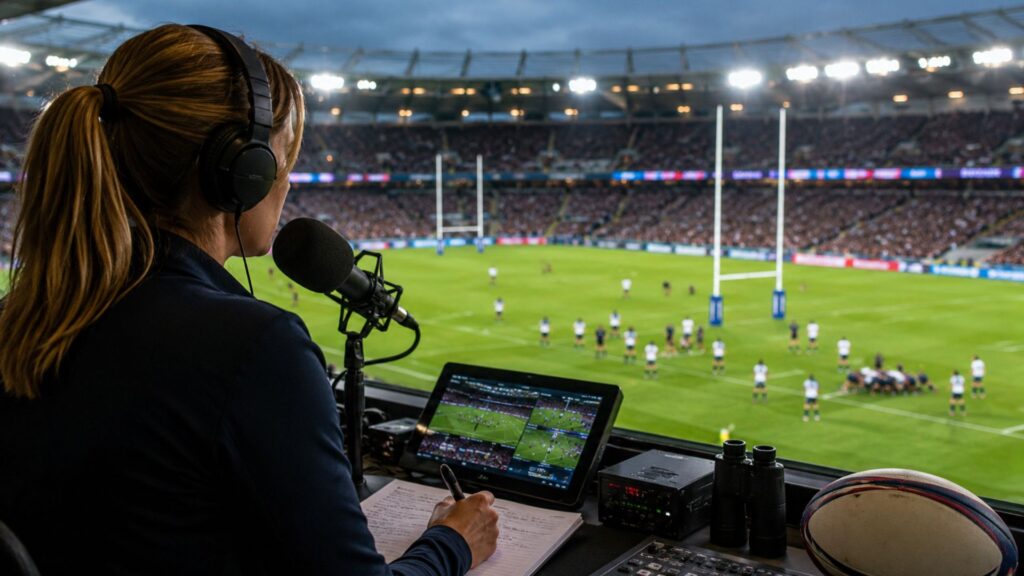

Sara Orchard has become one of the most recognisable voices in British sports broadcasting, particularly for rugby fans who follow the game on television, radio, and digital platforms. Her career reflects a combination of sporting knowledge, broadcasting experience, and years of preparation behind the microphone. As a BBC Sport reporter and commentator, she has covered major events across rugby and other sports while also building a reputation for clear, informed, and engaging commentary.
What makes her professional journey particularly interesting is her connection to rugby beyond broadcasting. Orchard has experience as a qualified rugby referee and coach, giving her an additional understanding of the sport she reports on. From her early experiences in local radio to major international tournaments, her story demonstrates how a strong knowledge of sport and dedication to journalism can create a long-lasting career in a competitive media industry.
Quick Bio
| Detail | Information |
|---|---|
| Full Name | Sara Orchard |
| Nationality | British |
| Profession | Sports Reporter, Broadcaster and Commentator |
| Known For | Rugby coverage and broadcasting |
| Major Association | BBC Sport and BBC Radio 5 Live |
| Sports Covered | Rugby, hockey, tennis, netball and other major events |
| Education | Studied Sports Science at Sheffield Hallam University |
| Rugby Experience | Qualified rugby referee and Level 2 coach |
| Birth Date | Not publicly confirmed by reliable sources |
| Marital Status | Not publicly confirmed by reliable sources |
Early Life and Education
Sara Orchard’s path into sport and broadcasting developed from an early interest in both communication and athletics. She attended Exeter School, where she studied subjects including Economics, English, and Theatre Studies. Her time there also helped strengthen her interest in rugby, and she was involved in helping establish the girls’ rugby team.
After finishing school, she went on to study Sports Science at Sheffield Hallam University. This educational background gave her a useful foundation for understanding athletic performance and sport, knowledge that later complemented her work as a journalist and commentator.
Her involvement with rugby was not limited to being a spectator. Orchard developed practical experience within the sport and became a qualified rugby referee and coach. That hands-on understanding has been an important part of her broadcasting identity. A commentator must do much more than describe what is happening during a match; they need to understand tactics, rules, decisions, players, and the wider context surrounding a competition.
Beginning a Career in Broadcasting
Before becoming widely known for national sports coverage, Orchard worked in local radio in Devon. Early broadcasting roles are often important training grounds, requiring presenters and reporters to work quickly, research thoroughly, and communicate information clearly.
Her career later took her to London, where she became established within BBC broadcasting. Over the years, her work has included BBC Sport, BBC Radio 5 Live, BBC London television and radio services, and other BBC platforms.
In a later interview about her career, Orchard described preparation as one of the central principles behind effective commentary. The amount of work completed before a match can be just as important as the time spent speaking on air. Researching players, analysing recent performances, studying teams, and understanding tactical developments all help a commentator explain the action accurately.
Her career also demonstrates that broadcasting opportunities can sometimes arise unexpectedly. Early commentary work can lead to bigger assignments when preparation, knowledge, and confidence come together at the right moment.
Sara Orchard and Rugby Commentary
Rugby remains the sport most closely associated with Sara Orchard. She has covered domestic and international rugby and has worked across important competitions involving both men’s and women’s teams.
Her BBC profile identifies her as a rugby reporter, while recent BBC work continues to feature her name on rugby stories and coverage. She has reported on developments affecting England rugby, Premiership Women’s Rugby, the Women’s Six Nations, and other major stories connected with the game.
A major strength of her work is the combination of reporting and commentary. These are related but different skills. Reporting requires gathering information, interviewing people, checking facts, and explaining developments. Live commentary requires rapid observation, concentration, timing, and the ability to communicate clearly while events unfold.
Her background as a referee and coach adds another dimension. Understanding the laws of rugby and the reasoning behind decisions can help explain complicated moments to audiences. Rugby can move quickly, and decisions involving scrums, tackles, breakdowns, and other technical areas are sometimes difficult for casual viewers to follow.
A Career Across Major Sporting Events
Although rugby is central to her professional identity, Orchard’s experience extends beyond one sport. During her career, she has covered hockey and tennis as well as major multi-sport events.
Her past assignments have included the Olympic Games, Commonwealth Games, Wimbledon, the US Open, and European Championship hockey. She also worked on Olympic-related coverage over several years, including major international events connected with the Olympic movement.
This broader experience highlights an important quality of successful sports broadcasters: adaptability. Different sports require different levels of knowledge, vocabulary, pacing, and storytelling. A radio audience, for example, depends heavily on the commentator to create a clear picture of events. Television viewers can see the action but still rely on commentators for insight and context.
Orchard has worked in both environments. Her ability to operate across television, radio, reporting, and live commentary has helped make her a versatile figure in sports media.
Her Contribution to Women’s Rugby
The growth of women’s rugby has been one of the major developments in modern sport, and Orchard has been closely connected with its coverage. Through her reporting and commentary, she has covered leading players, international tournaments, and the continued development of the women’s game.
Women’s rugby has gained larger audiences, increased investment, and greater media attention over time. This growth has created a greater need for experienced journalists and commentators who know the history of the sport and can explain its current direction.
Orchard has also spoken about the importance of preparation and professional neutrality. Even when covering a major match involving a team that attracts strong public support, a commentator must focus on the action and provide fair coverage.
Her long experience in broadcasting is also significant because sports media has historically been dominated by men, particularly in areas such as rugby commentary. Professional expertise and consistency have helped more women gain opportunities in broadcasting, and Orchard’s career forms part of that wider change.
What Makes Her Commentary Style Effective?
Good commentary is often difficult to notice when it is done well. The commentator must provide useful information without overwhelming the action. They must know when to explain, when to react, and when to allow an important sporting moment to speak for itself.
Preparation is one of the strongest themes associated with Orchard’s approach. Studying statistics, team selections, player backgrounds, recent form, and tactical changes allows a broadcaster to respond intelligently during a live event.
Her rugby experience also gives her a practical perspective. A person who has been involved with refereeing and coaching understands the game from more than one angle. This can be especially valuable when explaining technical decisions or tactical patterns to an audience.
Another important quality is versatility. Her experience across multiple sports and broadcasting formats has required her to adjust her approach for different audiences and events.
Public Information and Personal Privacy
Despite her public career, some details about Sara Orchard’s private life are not reliably confirmed. Information about her exact date of birth, age, husband or partner, and personal net worth should therefore not be presented as established fact without strong, trustworthy evidence.
This distinction matters when writing about broadcasters and public figures. A successful career can be discussed through verifiable professional achievements, published work, and official media profiles without inventing or exaggerating private information.
For readers interested in her career, the most reliable picture comes from her professional work: her years with the BBC, her experience in rugby broadcasting, her background in refereeing and coaching, and her coverage of major sporting events.
Why Sara Orchard’s Career Continues to Matter
Sara Orchard’s career represents the value of knowledge, preparation, and adaptability in sports journalism. She has developed from local radio into an experienced broadcaster covering some of the biggest competitions and stories in international sport.
Her work is particularly important within rugby, where she has established herself as a familiar and trusted broadcasting voice. At the same time, her experience in hockey, tennis, Olympic coverage, and other sporting events shows that her professional abilities extend well beyond a single field.
As women’s sport continues to attract new audiences and greater attention, experienced broadcasters with a deep understanding of their subjects remain essential. Orchard’s combination of journalistic skill and rugby knowledge has helped her build a distinctive career in this changing landscape.
For readers who enjoy discovering the stories behind influential figures in media, sport, and popular culture, The Pure Magazine continues to explore the careers and achievements that shape modern conversations. Sara Orchard’s journey from local broadcasting to major sporting coverage is a strong example of how experience, preparation, and genuine knowledge can create a respected and lasting presence in sports media.
FAQs About Sara Orchard
Who is Sara Orchard?
Sara Orchard is a British sports reporter, broadcaster, and commentator best known for her work covering rugby for BBC platforms.
What is Sara Orchard known for?
She is particularly known for rugby reporting and commentary, including coverage of major men’s and women’s rugby competitions.
Does Sara Orchard have rugby experience outside broadcasting?
Yes. Public professional profiles describe her as a qualified rugby referee and Level 2 coach.
Where did Sara Orchard study?
She studied Sports Science at Sheffield Hallam University after attending Exeter School.
What sports has Sara Orchard covered?
Alongside rugby, her career has included coverage of sports and events such as hockey, tennis, the Olympic Games, the Commonwealth Games, Wimbledon, and the US Open.
Is Sara Orchard’s age or date of birth publicly confirmed?
There is no widely reliable, officially confirmed public information establishing her exact date of birth or age.
to her experience covering major international sporting events.
You May Also Readr https://thepuremagazine.co.uk/