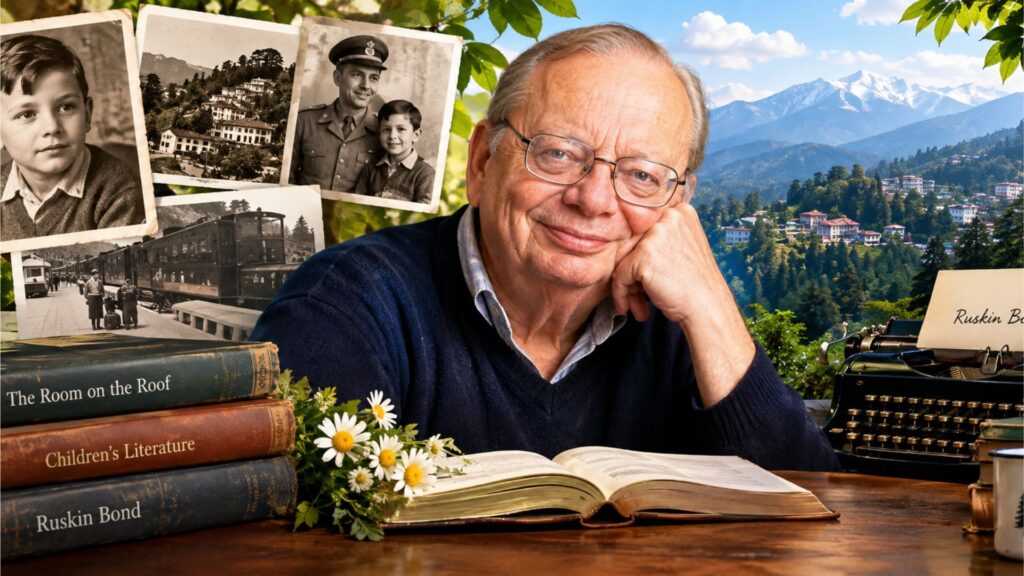

Ruskin Bond is one of the most widely loved writers in Indian literature, particularly among readers who grew up with his stories of hills, forests, railways, friendship, and childhood. His writing is often admired for its simplicity, warmth, and deep connection with nature. Behind these memorable stories was a childhood filled with happiness, travel, family changes, loneliness, books, and personal loss. Understanding the childhood of Ruskin Bond helps readers see how his early experiences shaped the writer he eventually became.
| Quick Bio | Details |
|---|---|
| Full Name | Ruskin Bond |
| Date of Birth | 19 May 1934 |
| Birthplace | Kasauli, British India |
| Nationality | Indian |
| Profession | Author and Writer |
| Known For | Children’s literature, short stories and novels |
| School | Bishop Cotton School, Shimla |
| Famous Work | The Room on the Roof |
| Major Influence | Nature, childhood memories, books and the Himalayan region |
Early Childhood and Family Background
Ruskin Bond was born on 19 May 1934 in Kasauli, a hill town in northern India. He was born into a family with British and Anglo-Indian roots. His father, Aubrey Alexander Bond, worked as an educator and later served in the Royal Air Force, while his mother was Edith Clarke.
Although Bond spent his early years in different parts of India, many of his strongest childhood memories came from the places where he lived with his family. His childhood was not settled in one location. Instead, it involved movement from one city to another, exposing him to different people, landscapes, cultures, and ways of life.
These early journeys became important to his imagination. Years later, Bond would write stories in which places were not simply backgrounds. Hills, railway stations, forests, small towns, old houses, and quiet streets often became memorable parts of the story. This close attention to surroundings can be traced back to the curious and observant child he once was.
Growing Up in Jamnagar
One of the important locations connected with Ruskin Bond’s childhood was Jamnagar in Gujarat. His father worked there as an English teacher and was associated with the education of children from the royal family.
Bond spent some of his earliest years in Jamnagar and remembered the period with affection. Childhood offered him opportunities to explore, observe, listen, and imagine. Old buildings, interesting people, household stories, and the everyday atmosphere of the place became part of his memory.
For a future writer, these experiences were valuable. Bond developed the habit of noticing ordinary details that other people might ignore. This ability later became one of the defining features of his work. A tree, a small room, a railway platform, a stranger, or a child walking through the hills could become the beginning of a meaningful story.
The Separation of His Parents
Ruskin Bond’s childhood was also affected by his parents’ separation. Family changes during his early years created emotional difficulties and brought periods of uncertainty.
Despite these changes, Bond developed a particularly close relationship with his father. His father became one of the most important figures in his childhood and had a lasting influence on his personality.
The relationship between father and son was filled with shared experiences, conversations, books, walks, and small moments of happiness. Bond later remembered his father with deep affection, and these memories appeared in his autobiographical writing.
The importance of this relationship can also be seen in Bond’s understanding of childhood emotions. Many of his stories are sensitive to feelings of loneliness, friendship, belonging, and the desire for companionship. These themes were not accidental. They reflected experiences that Bond himself understood from an early age.
Happy Days With His Father
For a period, Ruskin Bond lived with his father in Delhi. He later described this time as one of the happiest chapters of his childhood.
The father and son spent time together exploring the city and enjoying ordinary pleasures. These memories included outings, books, films, food, conversations, and the simple comfort of being together.
His father encouraged his interest in reading and helped him develop curiosity about the world. For Bond, books were not merely educational objects. They opened doors to imagination and adventure.
The closeness he shared with his father gave him a sense of security during a childhood that was otherwise changing in many ways. Unfortunately, this happy period did not last forever.
The Loss of His Father
One of the most painful moments in Ruskin Bond’s childhood came in 1944 when his father died from malaria. Bond was about ten years old at the time.
The death had a deep emotional impact on him. His father had been one of the people closest to him, and losing him created a sense of absence that remained important throughout his life.
Many writers draw inspiration from powerful emotional experiences, and Bond was no exception. His memories of his father continued to appear in his writing. However, he did not usually present loss in an exaggerated way. Instead, his work often carries a quiet emotional depth.
This ability to write about sadness with simplicity may be one reason why readers of different ages connect with his stories. His characters often experience difficult emotions, but they also find comfort in friendship, memory, nature, and the small pleasures of everyday life.
School Life and Bishop Cotton School
Ruskin Bond attended Bishop Cotton School in Shimla, one of India’s well-known boarding schools. His school years were an important stage in his development as a reader and writer.
Like many young students, Bond did not always see school as an entirely enjoyable experience. Boarding school could also be lonely, especially for a child separated from family. However, the school library became an important place for him.
Reading gradually became one of the central passions of his life. Books allowed him to travel into imaginary worlds and discover different styles of storytelling. He read children’s stories, adventure tales, classics, and other forms of literature.
His interest in writing also grew during these years. He participated in literary activities and won recognition for his writing at school. These early achievements encouraged him to take his talent seriously.
A Childhood Surrounded by Books
Books played a major role in the childhood of Ruskin Bond. Reading was not simply a pastime; it became a lifelong companion.
As a young reader, he enjoyed stories that stimulated his imagination. Children’s classics and comics helped create his early reading habit, while school libraries introduced him to a wider world of literature.
This love of reading eventually led naturally toward writing. A child who spent hours discovering stories began to imagine stories of his own.
Bond’s later writing for children shows that he never completely lost touch with the world of his younger self. He understood that children are curious, imaginative, observant, and capable of experiencing both happiness and sadness deeply.
His stories rarely speak down to young readers. Instead, they treat childhood as an important stage of life filled with genuine emotions and discoveries.
Nature and the World Around Him
Another major influence on Ruskin Bond’s childhood was nature. He spent important years in and around places such as Jamnagar, Delhi, Shimla, Dehradun, and the Himalayan foothills.
The mountains and forests of northern India eventually became especially important to him. Trees, birds, rain, rivers, gardens, insects, and changing seasons appeared repeatedly in his work.
Bond’s descriptions of nature feel personal because they are based on close observation. For him, nature was not something distant or decorative. It was part of everyday life.
His childhood experiences taught him to appreciate quiet moments. A walk through the hills, the sound of rain, a flowering tree, or the sight of a train could hold a sense of wonder. This appreciation later became one of the strongest qualities of his literary style.
Loneliness, Imagination, and Personal Growth
The childhood of Ruskin Bond was not without loneliness. His parents’ separation, life at boarding school, and the death of his father all affected him deeply.
However, loneliness also encouraged imagination. Reading and writing gave him a private world in which he could explore his thoughts and emotions.
This may explain why friendship is such an important theme in his stories. His characters often form unexpected connections with strangers, animals, neighbors, or fellow children. These relationships bring warmth and meaning into ordinary lives.
Bond understood that childhood could be joyful and painful at the same time. A child might enjoy an adventure while also missing home. A beautiful day could exist alongside feelings of sadness. His ability to capture these mixed emotions gave his writing authenticity.
The Beginning of a Writing Career
By his teenage years, Ruskin Bond had begun to take writing seriously. He wrote early stories and continued developing his skills.
At the age of seventeen, he began writing The Room on the Roof, a novel that would become one of his best-known works. The story reflected many of the emotions and experiences associated with adolescence, independence, identity, and growing up.
The success of his early writing showed that the imaginative child who had spent years reading, observing, and remembering had found his voice.
His childhood had provided him with more than memories. It had given him a way of seeing the world.
How Childhood Shaped Ruskin Bond’s Legacy
The childhood of Ruskin Bond remains essential to understanding his work. His early experiences in different Indian cities, his close relationship with his father, his love of books, the loss he experienced, and his connection with nature all contributed to his development as a writer.
His stories continue to appeal to readers because they celebrate simple experiences that are often overlooked. Childhood friendships, family memories, quiet journeys, natural beauty, and moments of solitude all have a place in his literary world.
Ruskin Bond transformed personal memories into stories that readers could recognize as their own. His childhood was filled with both happiness and hardship, yet he found inspiration in both. That ability to discover beauty in ordinary life is one of the reasons his work has remained popular across generations. For readers who enjoy exploring the lives and experiences behind remarkable writers, The Pure Magazine, Stories Beyond the Ordinary, offers a place to discover engaging stories that connect biography, memory, literature, and the extraordinary meaning hidden within everyday life.
FAQs
Where was Ruskin Bond born?
Ruskin Bond was born in Kasauli, British India, on 19 May 1934.
Where did Ruskin Bond spend his childhood?
He spent his early years in several places, including Jamnagar, Delhi, Shimla, Dehradun, and other parts of northern India.
Who had the greatest influence on Ruskin Bond during childhood?
His father, Aubrey Alexander Bond, was one of the most important influences on his early life, particularly through their close relationship and his encouragement of Bond’s interest in reading.
How did Ruskin Bond’s childhood influence his writing?
His childhood experiences of family, loneliness, friendship, travel, books, and nature provided inspiration for many of his stories and helped shape his simple and emotionally sensitive writing style.
Which book tells readers about Ruskin Bond’s childhood?
When I Was a Boy: Scenes and Stories from My Childhood contains memories and stories based on his early life.
When did Ruskin Bond begin writing?
He developed an interest in writing during his school years and wrote seriously as a teenager, later beginning The Room on the Roof when he was seventeen.
You May Also Readr https://thepuremagazine.co.uk/