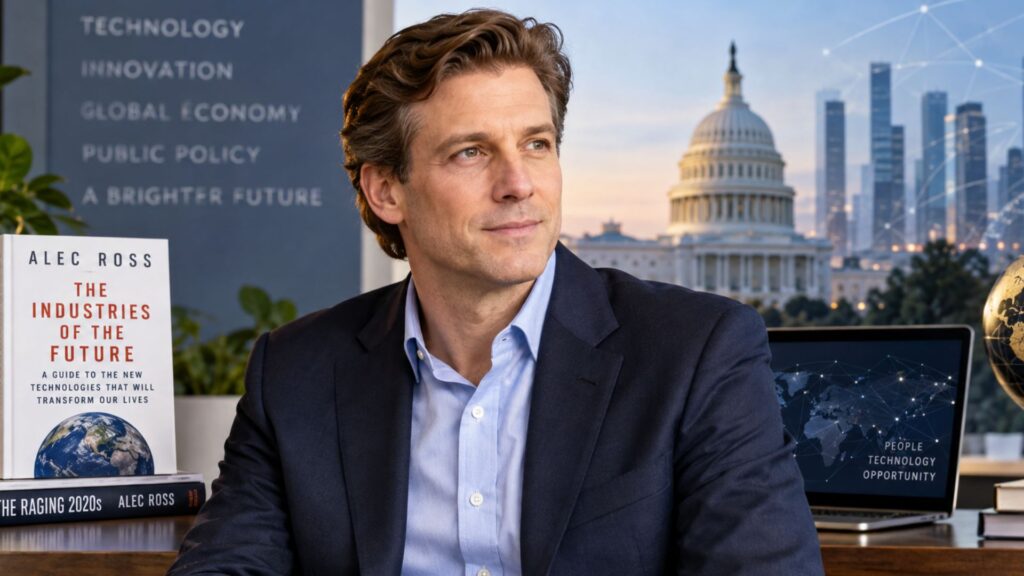

Alec Ross is an American author, entrepreneur, educator, and technology policy expert whose career has focused on the relationship between innovation, government, business, and society. He became widely recognized through his work in the U.S. government, particularly as Senior Advisor for Innovation to Secretary of State Hillary Clinton. Before entering government, Ross worked in education and helped establish a technology-focused nonprofit. Later, he became a bestselling author and an influential voice on emerging technologies, geopolitics, economic change, and the future of work. Today, his professional activities continue to connect technology, business, education, and public policy.
Quick Bio of Alec Ross
| Personal Detail | Information |
|---|---|
| Full Name | Alec Ross |
| Nationality | American |
| Profession | Author, entrepreneur, educator and technology policy expert |
| Education | Northwestern University |
| Early Career | Sixth-grade teacher through Teach For America |
| Government Position | Senior Advisor for Innovation to Secretary of State Hillary Clinton |
| Political Campaign Role | Technology & Media Policy Committee, Barack Obama’s 2008 campaign |
| Best Known Book | The Industries of the Future |
| Other Major Book | The Raging 2020s |
| Academic Role | Distinguished Visiting Professor, Bologna Business School |
| Venture Capital Role | Board Partner at Amplo |
Early Career and Education
Alec Ross began his professional journey in education rather than government or technology. After graduating from Northwestern University, he joined Teach For America and worked as a sixth-grade teacher in inner-city Baltimore. His early experience in education helped shape his interest in opportunity, technology, and the challenges faced by communities that did not always have equal access to resources.
Ross subsequently moved toward technology and social entrepreneurship. In 2000, he and three colleagues co-founded One Economy, a nonprofit organization that used technology and information to address issues affecting low-income communities. The organization focused on providing useful information about subjects such as education, employment, health care, and other essential areas.
This early work was significant because it connected Ross’s interest in technology with a broader question: how can technological progress improve people’s lives? That question remained an important theme throughout his later work in government, business, and writing.
Political and Government Career
Ross entered national politics during Barack Obama’s 2008 presidential campaign. He served as convener of the campaign’s Technology & Media Policy Committee and later became part of the Obama-Biden Presidential Transition Team. These positions placed him at the intersection of politics and rapidly developing digital technologies.
His government career reached its most prominent stage when he became Senior Advisor for Innovation to Secretary of State Hillary Clinton. He served throughout Clinton’s tenure as Secretary of State, beginning in 2009.
The position was created around the idea that emerging technologies could be used to modernize diplomacy and support U.S. foreign-policy objectives. Ross worked on the use of technologies such as the internet, mobile communication, and social media in international affairs. The State Department described his responsibilities as maximizing the potential of technology in support of America’s diplomatic and development goals.
His work was closely connected with the concept of “21st Century Statecraft,” which examined how governments could adapt traditional diplomacy to an increasingly connected world. During this period, technology was becoming an increasingly important tool for communication between governments, citizens, organizations, and communities.
Global Perspective on Technology
One of the most important aspects of Ross’s government experience was its international dimension. During his research for his first major book, he traveled to 41 countries while examining technological and economic developments in different parts of the world. His travels exposed him to startup communities, research centers, businesses, and emerging technology ecosystems.
This global perspective influenced his understanding of innovation. Rather than viewing technological development only through Silicon Valley or the United States, Ross examined how different countries were approaching robotics, artificial intelligence, cybersecurity, biotechnology, big data, and digital finance.
His international experience also helped him connect technological change with broader economic and geopolitical trends.
The Industries of the Future
Ross became especially well known as an author after publishing The Industries of the Future. The book became a New York Times bestseller and was translated into 24 languages. It explores technologies and industries that Ross believed would have an especially important influence on the global economy.
Among the subjects covered in the book are robotics and artificial intelligence, cybersecurity and cybercrime, genomics, big data, and the changing role of digital technology in money and markets.
A major strength of the book is its attempt to look beyond individual inventions. Ross considers how technological change can affect employment, education, economic competition, and society. His approach asks readers to think not only about what technology can do, but also about how individuals and institutions should prepare for its consequences.
The book helped establish Ross as a public commentator capable of explaining complicated technological developments to a broad audience.
Academic and Professional Work
After leaving the Department of State in 2013, Ross expanded his work in academia and business. He became a Visiting Professor at King’s College London and later served as a Distinguished Senior Fellow at Columbia University’s School of International and Public Affairs. Bologna Business School identifies him as a Distinguished Visiting Professor and highlights his expertise in technology, geopolitics, economics, and innovation.
Ross has also remained active in the private sector. He is a Board Partner at Amplo, a global venture capital firm, and has served on boards or advisory boards involving technology, finance, education, human capital, and cybersecurity.
His combination of government experience, academic work, entrepreneurship, and investment gives him a broad perspective on the development of emerging industries.
The Raging 2020s
Ross later wrote The Raging 2020s: Companies, Countries, People—and the Fight for Our Future. The book expands his focus from emerging technologies to the broader relationship between citizens, companies, and governments.
The central concern is how major economic, technological, and political changes are affecting the balance of power within society. Ross examines the challenges created when institutions struggle to keep pace with rapid change and considers how a new social contract could help address those challenges. His official website describes the book as an examination of the relationship between government, citizens, and business during a period of unprecedented global change.
This work demonstrates how Ross’s thinking has developed beyond technology forecasting. His interests now include the political and economic consequences of innovation and the ways institutions can respond to disruption.
Recognition and Influence
Ross has received several notable honors during his career. His recognitions include the U.S. Department of State Distinguished Honor Award, the Oxford University Internet & Society Award, and recognition from Foreign Policy magazine as one of its Top 100 Global Thinkers. The Industries of the Future also received the TriBeCa Film Festival Book of the Year recognition.
His writing has appeared in publications including The Wall Street Journal and Foreign Policy, while his academic writing has appeared in publications such as SAIS Review of International Affairs and NATO Review.
Alec Ross and the Future of Work
A recurring subject in Ross’s work is the future of employment. Artificial intelligence, automation, robotics, and digital systems are changing the skills required by businesses and workers. Ross has explored how education and retraining can help people adapt to these changes.
His perspective is particularly relevant as organizations increasingly consider the impact of AI and automation on jobs. Rather than treating technology simply as a threat or opportunity, his work encourages businesses, governments, and educators to think about how people can prepare for an evolving labor market.
Why Alec Ross Remains Relevant
Alec Ross remains relevant because his career crosses several areas that are increasingly connected. Technology now influences diplomacy, business, education, employment, finance, and international relations. Ross’s professional experience allows him to examine these developments from multiple perspectives.
His journey from classroom teacher to nonprofit entrepreneur, presidential campaign adviser, senior government official, author, professor, and venture capital professional is also unusual. Each stage of his career contributed to his understanding of how innovation affects society.
For readers interested in technology and the future, Ross offers a perspective that combines practical experience with long-term analysis. His books and public discussions continue to examine the opportunities and difficulties created by rapid technological and economic change.
Conclusion
Alec Ross has built a distinctive career around innovation and its wider consequences. From teaching in Baltimore and co-founding One Economy to working on Barack Obama’s presidential campaign and serving as a senior innovation adviser to Hillary Clinton, his professional journey has consistently connected technology with public life.
His bestselling The Industries of the Future brought his ideas about emerging industries to a worldwide audience, while The Raging 2020s broadened his discussion toward government, business, citizens, and the future of society. His continuing work in academia, venture capital, and public speaking keeps him engaged with the technological and economic developments shaping the modern world. For more informative stories about notable people, technology, business, and ideas, readers can explore The Pure Magazine, where stories go beyond the ordinary.
FAQs About Alec Ross
Who is Alec Ross?
Alec Ross is an American author, entrepreneur, educator, and technology policy expert known for his work on innovation and emerging technologies.
What is Alec Ross best known for?
He is best known for serving as Senior Advisor for Innovation to Secretary of State Hillary Clinton and for writing the New York Times bestselling book The Industries of the Future.
What books has Alec Ross written?
His major books include The Industries of the Future and The Raging 2020s: Companies, Countries, People—and the Fight for Our Future.
Did Alec Ross work with Hillary Clinton?
Yes. Ross served as Senior Advisor for Innovation to Hillary Clinton while she was U.S. Secretary of State.
What did Alec Ross do before working in government?
Ross began his career as a sixth-grade teacher through Teach For America and later co-founded One Economy, a nonprofit focused on using technology to provide information and opportunities to low-income communities.
What is Alec Ross’s connection to Bologna Business School?
Ross is a Distinguished Visiting Professor at Bologna Business School, where his areas of expertise include innovation, technology, geopolitics, and the changing global economy.
You May Also Readr https://thepuremagazine.co.uk/