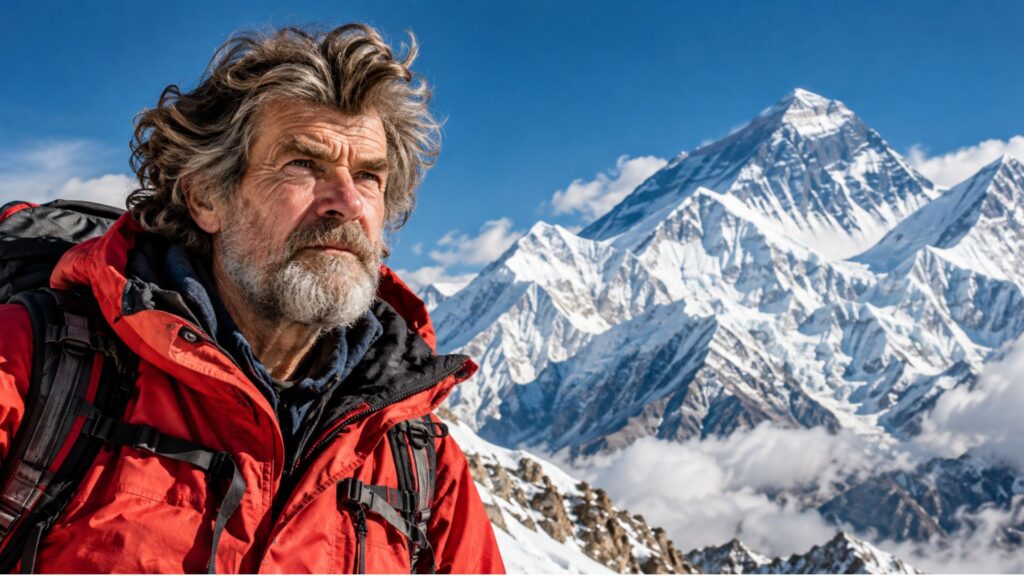


Reinhold Messner is an Italian mountaineer, explorer, author and former politician, widely known for his pioneering achievements in high-altitude climbing. Born in South Tyrol, Italy, he became internationally recognized for climbing Mount Everest without supplemental oxygen and completing ascents of all 14 of the world’s 8,000-metre peaks without bottled oxygen. His mountaineering career also includes solo expeditions, challenging new routes and explorations across remote regions of the world.
The following research compiles biographical details, major achievements, expeditions, family background, books, awards and other information to help you prepare an informative, SEO-friendly article about Reinhold Messner.
1. Quick Biography of Reinhold Messner
| Detail | Information |
|---|---|
| Full name | Reinhold Andreas Messner |
| Date of birth | 17 September 1944 |
| Age | 82? |
| Birthplace | Brixen (Bressanone), South Tyrol, Italy |
| Nationality | Italian |
| Profession | Mountaineer, explorer, author and politician |
| Known for | High-altitude mountaineering and exploration |
| Famous achievement | First person to climb all 14 eight-thousanders without supplemental oxygen |
| Mount Everest achievement | First ascent without supplemental oxygen with Peter Habeler in 1978 |
| Solo Everest achievement | First solo ascent of Everest without supplemental oxygen in 1980 |
| Brother | Günther Messner |
| Political career | Member of the European Parliament, 1999–2004 |
| Books | More than 80 publications |
| Museums | Founder of the Messner Mountain Museum network |
| Awards | Piolet d’Or Lifetime Achievement Award, Princess of Asturias Award |
| Birth year | 1944 |
Note: Messner turned 82 on 17 September 2026. His date of birth and career details are documented by the German Patent and Trade Mark Office and the UIAA.
Reinhold Messner
2. Early Life and Childhood
Reinhold Messner was born on 17 September 1944 in Brixen, a town in South Tyrol, a German-speaking region of northern Italy. He grew up in a large family with several siblings, including his younger brother Günther Messner. His childhood in the mountainous landscape of the Dolomites played an important role in developing his interest in climbing.
His father, Josef Messner, was a teacher and an experienced mountaineer who introduced Reinhold and his siblings to mountain climbing at an early age. Messner began climbing as a child and developed considerable experience on the challenging rock faces and peaks of the Dolomites.
By his teenage years, he was already undertaking demanding climbs. His early experiences helped him develop technical climbing skills, confidence and an interest in exploring difficult mountain routes.
Unlike mountaineers who relied on large expeditions and extensive equipment, Messner gradually developed a preference for lightweight climbing, minimal assistance and independent decision-making. These principles later became central to his approach to Himalayan mountaineering.
Reinhold Messner
3. Reinhold Messner’s Mountaineering Career

Reinhold Messner’s professional mountaineering career developed during a period when Himalayan expeditions were often organized around large teams, fixed ropes, high-altitude camps and supplemental oxygen.
Messner explored an alternative approach, emphasizing what is known as Alpine style. This method involves carrying limited equipment, avoiding prepared camps and fixed ropes where possible, and relying on a small team or climbing independently.
His approach was particularly significant in the Himalayas, where altitude, unpredictable weather, avalanches and limited oxygen create serious challenges.
During his career, Messner completed thousands of climbs, including numerous difficult ascents and new routes. His expeditions extended beyond the Himalayas to other mountain ranges and remote environments. The International Climbing and Mountaineering Federation (UIAA) recognized his contributions by making him an honorary member in 2016.
Reinhold Messner
4. Major Achievements of Reinhold Messner

First Everest ascent without supplemental oxygen (1978)
On 8 May 1978, Reinhold Messner and Austrian mountaineer Peter Habeler reached the summit of Mount Everest without using supplemental bottled oxygen. Their achievement challenged prevailing expectations about the human body’s ability to function at extreme altitude.
Reinhold Messner

First solo ascent of Everest without supplemental oxygen (1980)
In 1980, Messner climbed Mount Everest alone, without supplemental oxygen, during the monsoon season. He followed a new route on the North Face, making this one of the defining achievements of his mountaineering career.
Reinhold Messner

First solo ascent of an eight-thousander (1978)
Messner completed a solo ascent of Nanga Parbat in 1978, reaching the summit from base camp. The expedition demonstrated his commitment to independent high-altitude climbing.
Reinhold Messner

Ascent of K2 without supplemental oxygen (1979)
In 1979, Messner climbed K2, the world’s second-highest mountain, with Michael Dacher. K2 is known for its difficult terrain, severe weather and technical climbing challenges.
Kiwix Server

Completion of all 14 eight-thousanders (1986)
In 1986, Messner completed his ascents of all 14 mountains exceeding 8,000 metres, becoming the first person recorded to achieve this feat without supplemental oxygen. Guinness World Records documents his oxygen-free completion in 1986.
Guinness World Records
5. Reinhold Messner and the 14 Eight-Thousanders
The term eight-thousander refers to a mountain with a summit higher than 8,000 metres above sea level. There are 14 such mountains in the world, all located in the Himalayas and Karakoram ranges of Asia.
Messner climbed all 14 during a period spanning from 1970 to 1986. His achievement was particularly notable because he completed the ascents without supplemental bottled oxygen.
| Mountain | Height (approx.) | Year |
|---|---|---|
| Nanga Parbat | 8,126 m | 1970 |
| Manaslu | 8,163 m | 1972 |
| Gasherbrum I | 8,080 m | 1975 |
| Mount Everest | 8,849 m | 1978 |
| K2 | 8,611 m | 1979 |
| Shishapangma | 8,027 m | 1981 |
| Kangchenjunga | 8,586 m | 1982 |
| Gasherbrum II | 8,035 m | 1982 |
| Broad Peak | 8,051 m | 1982 |
| Cho Oyu | 8,188 m | 1983 |
| Annapurna I | 8,091 m | 1985 |
| Dhaulagiri I | 8,167 m | 1985 |
| Makalu | 8,485 m | 1986 |
| Lhotse | 8,516 m | 1986 |
Heights are rounded and can vary slightly between geographic references. The ascent chronology is based on historical expedition records.
Guinness World Records
His achievement has also been subject to later scrutiny over the precise summit points reached on certain mountains. For an article, it is useful to distinguish his historically recorded accomplishment from subsequent discussions about summit verification.
6. The Tragic Expedition with His Brother Günther Messner

One of the most significant and difficult experiences in Reinhold Messner’s life was the 1970 expedition to Nanga Parbat in Pakistan, during which his younger brother, Günther Messner, died.
The brothers were part of an expedition attempting to climb the mountain’s challenging Rupal Face. Reinhold reached the summit, and the descent took place on the opposite side of the mountain. Günther died during the expedition, and the circumstances surrounding his death became the subject of prolonged public debate.
Over the years, different accounts and interpretations of the expedition emerged, including questions about the route taken and the decisions made during the descent. Reinhold Messner maintained that his brother died during their descent after being caught in dangerous mountain conditions.
The loss had a lasting impact on Messner’s life and became an important part of his personal story. The expedition and the controversy surrounding it have also been examined in books, interviews and documentary productions. Brotherhood of the Mountain, published by Vanity Fair in 2006, is one example of journalistic coverage of the dispute.
Vanity Fair
7. Exploration Beyond Mountaineering


Messner’s interests extended beyond climbing the world’s highest mountains. He also became known for expeditions across remote environments, including polar regions and deserts.
Some of his notable explorations include:
- Antarctica: Messner took part in an expedition crossing Antarctica, exploring the continent’s demanding ice-covered terrain.
- Greenland: He undertook an expedition across Greenland, facing extreme cold, isolation and difficult travel conditions.
- Gobi Desert: He also explored the Gobi Desert, including a solo journey that reflected his interest in endurance and self-reliance.
These expeditions demonstrated that his interests were not limited to reaching mountain summits. He was also drawn to remote landscapes, exploration and the experience of travelling through challenging natural environments.
UIAA
8. Reinhold Messner as an Author
Reinhold Messner is also an established author who has written extensively about mountaineering, exploration, personal experiences and the relationship between humans and nature.
He has published more than 80 books, covering subjects such as Himalayan expeditions, the challenges of climbing without supplemental oxygen, mountain culture and the lessons he learned during his travels.
UIAA
His writing offers readers insight into the planning, uncertainty, risks and personal decisions involved in extreme expeditions. His books also document aspects of mountaineering history and the changing relationship between climbers and high-altitude environments.
For readers interested in his life, his autobiographical writing and expedition accounts provide additional perspectives beyond conventional biographies.
9. Messner Mountain Museum


Reinhold Messner established the Messner Mountain Museum (MMM), a museum network dedicated to mountain culture, mountaineering, nature and the relationship between people and mountainous environments.
The museum project reflects his interest in preserving and sharing the cultural and historical importance of mountains. The network includes several locations, each focusing on a different aspect of mountain life, art, history and exploration.
The museums provide opportunities for visitors to learn about mountain communities, climbing traditions, the natural environment and the history of exploration. Messner’s involvement in the project represents an important part of his work outside the climbing world.
UIAA
10. Political Career
Alongside his work as a mountaineer and author, Reinhold Messner also entered politics. In 1999, he was elected to the European Parliament, representing the Federation of the Greens in Italy.
He served as a Member of the European Parliament from 1999 to 2004. During this period, he was associated with environmental issues and the Green political movement. His political work reflected his longstanding interest in environmental protection and the relationship between human activity and the natural world.
Messner completed his parliamentary term in 2004 and subsequently returned his attention to other projects, including writing, museum development and environmental advocacy.
11. Awards and Recognition
Throughout his career, Reinhold Messner has received recognition from mountaineering organizations and cultural institutions for his achievements and contributions.
| Award or recognition | Year | Details |
|---|---|---|
| Piolet d’Or Lifetime Achievement Award | 2010 | Recognition of his contributions to mountaineering |
| UIAA Honorary Membership | 2016 | Recognition from the International Climbing and Mountaineering Federation |
| Princess of Asturias Award for Sports | 2018 | Jointly awarded to Messner and Krzysztof Wielicki |
| Guinness World Records recognition | Various | Historical records for pioneering climbing achievements |
Guinness World Records
These recognitions reflect different aspects of his career, including high-altitude climbing, exploration and his broader contribution to mountaineering.
12. Reinhold Messner’s Personal Life
Reinhold Messner has maintained a public identity closely associated with mountaineering, exploration, writing and environmental interests. He grew up in a large family in South Tyrol, where his early experiences in the mountains shaped his future career.
His younger brother Günther was an important part of his early mountaineering life, and his death during the 1970 Nanga Parbat expedition remained a defining personal experience.
Messner has also spoken publicly about family, personal responsibility and the importance of allowing younger generations to make their own choices. In a 2003 interview with The Guardian, he discussed how his own approach to climbing was not necessarily the right path for his children.
The Guardian
13. Reinhold Messner’s Legacy in Mountaineering
Reinhold Messner’s career contributed to changing ideas about high-altitude mountaineering. His oxygen-free ascent of Everest with Peter Habeler in 1978 demonstrated that the summit could be reached without bottled oxygen, while his solo ascent in 1980 further expanded the boundaries of established climbing practices.
His commitment to lightweight expeditions and Alpine-style climbing influenced subsequent generations of mountaineers. His achievements also prompted wider discussions about risk, individual responsibility, expedition ethics and the purpose of exploration.
In addition to his climbing records, Messner’s books, museum network and environmental interests have helped make mountaineering history accessible to a broader audience.
His career remains an important subject for anyone researching the development of modern Himalayan climbing and the history of exploration.
14. Frequently Asked Questions
1. Who is Reinhold Messner?
Reinhold Messner is an Italian mountaineer, explorer and author born in 1944 in South Tyrol, Italy. He is known for his pioneering high-altitude ascents, including climbing all 14 eight-thousanders without supplemental oxygen.
2. How old is Reinhold Messner?
Reinhold Messner was born on 17 September 1944. As of October 2026, he is 82 years old.
3. What is Reinhold Messner famous for?
He is famous for becoming the first person to climb all 14 of the world’s eight-thousanders without supplemental oxygen. He also made the first ascent of Mount Everest without supplemental oxygen alongside Peter Habeler in 1978 and the first solo ascent of Everest without supplemental oxygen in 1980.
4. Did Reinhold Messner climb Mount Everest without oxygen?
Yes. He climbed Everest with Peter Habeler without supplemental oxygen in 1978 and returned to complete a solo ascent without supplemental oxygen in 1980.
5. What happened to Reinhold Messner’s brother?
His younger brother Günther died during the 1970 Nanga Parbat expedition in Pakistan. The circumstances of his death and the events of the expedition later became the subject of public controversy.
6. How many books has Reinhold Messner written?
Messner has published more than 80 books about mountaineering, exploration, personal experiences and mountain culture.
7. Was Reinhold Messner a politician?
Yes. He served as a Member of the European Parliament from 1999 to 2004, representing the Federation of the Greens in Italy.
8. What is the Messner Mountain Museum?
The Messner Mountain Museum is a network of museums founded by Reinhold Messner. It focuses on mountain culture, mountaineering history, nature and exploration.
Early Life and Family Background
Reinhold Messner was born on 17 September 1944 in Brixen, a town in South Tyrol, northern Italy. He grew up in a large family with several siblings, including his younger brother Günther Messner. The surrounding mountains of the Dolomites played a significant role in shaping his childhood and developing his passion for climbing.
His father, Josef Messner, was a schoolteacher and an experienced mountaineer who introduced Reinhold and his siblings to the mountains at an early age. These early experiences gave him opportunities to develop climbing skills and become familiar with challenging alpine environments. Reinhold started climbing during childhood and quickly developed an interest in exploring difficult mountain routes.
As a teenager, he began undertaking demanding climbs in the Dolomites. His early achievements demonstrated his determination, physical ability and willingness to accept challenging conditions. Rather than viewing mountaineering simply as a recreational activity, Messner developed a deeper interest in understanding mountains and testing his own limits.
His upbringing in South Tyrol also influenced his appreciation of nature, independence and adventure. These qualities eventually became important elements of his approach to mountaineering and exploration.
Reinhold Messner’s Mountaineering Career
Reinhold Messner’s mountaineering career developed during a period when large expeditions, extensive equipment and supplemental oxygen were commonly used for climbing the world’s highest mountains. However, Messner preferred a different approach that emphasized lightweight equipment, small teams and individual responsibility.
He became a prominent advocate of Alpine-style climbing, which generally involves carrying limited supplies, avoiding fixed camps and minimizing external assistance. This approach allowed him to explore difficult routes while relying heavily on his own technical abilities and judgment.
During the early years of his career, Messner completed numerous challenging climbs in the Alps and Dolomites. His technical expertise and growing reputation eventually led him toward the Himalayas, where he began attempting some of the world’s most demanding mountains.
His philosophy was based on the belief that mountaineering should involve a direct relationship between the climber and the mountain. He challenged established climbing practices and demonstrated that extraordinary achievements were possible with careful preparation, experience and determination.
Historic Achievement on Mount Everest
One of the most significant milestones in Reinhold Messner’s career came in 1978 when he climbed Mount Everest alongside Austrian mountaineer Peter Habeler. On 8 May 1978, they reached the summit without using supplemental bottled oxygen. At the time, many experts believed that climbing Everest without additional oxygen was extremely dangerous and potentially impossible.
Their successful ascent changed perceptions of human endurance at extreme altitudes and became a landmark moment in mountaineering history. It demonstrated the importance of physical conditioning, experience, preparation and mental strength when facing the challenges of high-altitude environments.
Messner made history again in 1980 when he completed the first solo ascent of Mount Everest without supplemental oxygen. He climbed during the monsoon season and followed a challenging route on the mountain’s North Face. His achievement demonstrated his exceptional technical skills, independence and ability to make difficult decisions in extremely dangerous conditions.
These two expeditions established Messner as one of the most accomplished mountaineers of his generation and significantly influenced the development of modern high-altitude climbing.
Climbing All 14 Eight-Thousanders
Reinhold Messner’s most widely recognized achievement was becoming the first person to climb all 14 mountains in the world that rise above 8,000 metres without supplemental oxygen. These mountains are located in the Himalayan and Karakoram ranges of Asia and are considered among the most dangerous climbing destinations on Earth.
His journey toward this remarkable achievement began in 1970 with Nanga Parbat and continued through several challenging expeditions. He climbed Mount Everest in 1978, K2 in 1979 and numerous other high-altitude peaks throughout the early and mid-1980s.
In 1986, Messner completed his ascent of Lhotse, marking the completion of his historic collection of all 14 eight-thousanders. His achievement was particularly remarkable because climbing at such extreme elevations without supplemental oxygen requires extraordinary endurance and careful management of altitude-related risks.
Messner’s accomplishment helped redefine the possibilities of high-altitude mountaineering. It also inspired other climbers to explore lightweight expedition methods and pursue demanding ascents with greater independence.
The Tragic Loss of His Brother
One of the most difficult experiences in Reinhold Messner’s life occurred during the 1970 Nanga Parbat expedition, when his younger brother Günther Messner died. The brothers were participating in an expedition attempting the mountain’s challenging Rupal Face.
After reaching the summit, Reinhold and Günther descended under dangerous conditions. Günther died during the expedition, and the circumstances surrounding his death later became the subject of considerable public controversy and discussion.
Reinhold explained that his brother had become exhausted and that the descent had taken place under extremely difficult circumstances. Different accounts of the expedition emerged over the years, leading to disagreements and extensive media attention.
The loss deeply affected Messner and remained an important part of his personal story. He later wrote about the expedition and his brother, explaining the emotional impact of the tragedy and the lasting memories associated with their shared passion for mountaineering.
Exploration and Adventures Beyond the Mountains
Although Reinhold Messner is primarily known for his Himalayan achievements, his adventurous interests extend far beyond mountain climbing. He has undertaken expeditions in some of the world’s most remote and challenging environments, including Antarctica, Greenland and the Gobi Desert.
His polar expeditions involved travelling across vast icy landscapes, where extreme cold, isolation and unpredictable weather presented serious challenges. His desert explorations also tested his endurance and ability to survive in difficult natural conditions.
These journeys reflected Messner’s broader interest in exploration and his desire to understand the natural world. He has consistently emphasized the importance of respecting nature and recognizing the physical and psychological challenges involved in travelling through remote environments.
Reinhold Messner as an Author and Museum Founder
In addition to his achievements as a mountaineer, Reinhold Messner has established himself as a successful author. He has written more than 80 books covering mountaineering, exploration, personal experiences and mountain culture. His publications share insights into his expeditions, climbing philosophy and the challenges of exploring dangerous environments.
Messner also founded the Messner Mountain Museum, a network of museums dedicated to mountain culture, history, nature and exploration. The museums preserve the heritage of mountaineering and provide visitors with opportunities to understand the importance of mountains in human life.
Political Career and Environmental Advocacy
Messner also entered politics and served as a Member of the European Parliament from 1999 to 2004, representing the Italian Green movement. His political interests included environmental protection, sustainable development and the conservation of natural landscapes.
His environmental advocacy reflects his lifelong connection with mountains and remote environments. Through his public activities, he has encouraged greater awareness of the importance of protecting nature and respecting the world’s fragile ecosystems.
Personal Life and Legacy
Reinhold Messner has built a life around adventure, independence and exploration. Despite facing dangerous situations and personal tragedies, he continued pursuing challenging expeditions and sharing his experiences through writing and public appearances.
His legacy extends beyond his climbing records. He helped popularize lightweight mountaineering, inspired generations of climbers and contributed to preserving mountain culture through his museums and publications. His achievements remain an important part of modern mountaineering history.
Today, Reinhold Messner is remembered as a pioneering explorer whose determination and adventurous spirit transformed the possibilities of high-altitude climbing. His remarkable journey continues to inspire people interested in adventure, endurance and the natural world. For readers of The Pure Magazine, his story is an example of how dedication, courage and a passion for exploration can leave a lasting mark on the world.
Frequently Asked Questions
Who is Reinhold Messner?
Reinhold Messner is an Italian mountaineer, explorer and author, widely known for climbing all 14 of the world’s eight-thousanders without supplemental oxygen.
How old is Reinhold Messner?
He was born on 17 September 1944 and is 82 years old as of 2026.
Did Reinhold Messner climb Mount Everest without oxygen?
Yes, he climbed Mount Everest without supplemental oxygen with Peter Habeler in 1978 and completed the first solo ascent without supplemental oxygen in 1980.
How many mountains did Reinhold Messner climb above 8,000 metres?
He became the first person to climb all 14 eight-thousanders without supplemental oxygen, completing the achievement in 1986.
What happened to Reinhold Messner’s brother?
His younger brother, Günther Messner, died during their 1970 expedition to Nanga Parbat in Pakistan.
What is Reinhold Messner famous for besides climbing?
He is also known as an author, explorer, environmental advocate, museum founder and former Member of the European Parliament.
You May Also Readr https://thepuremagazine.co.uk/