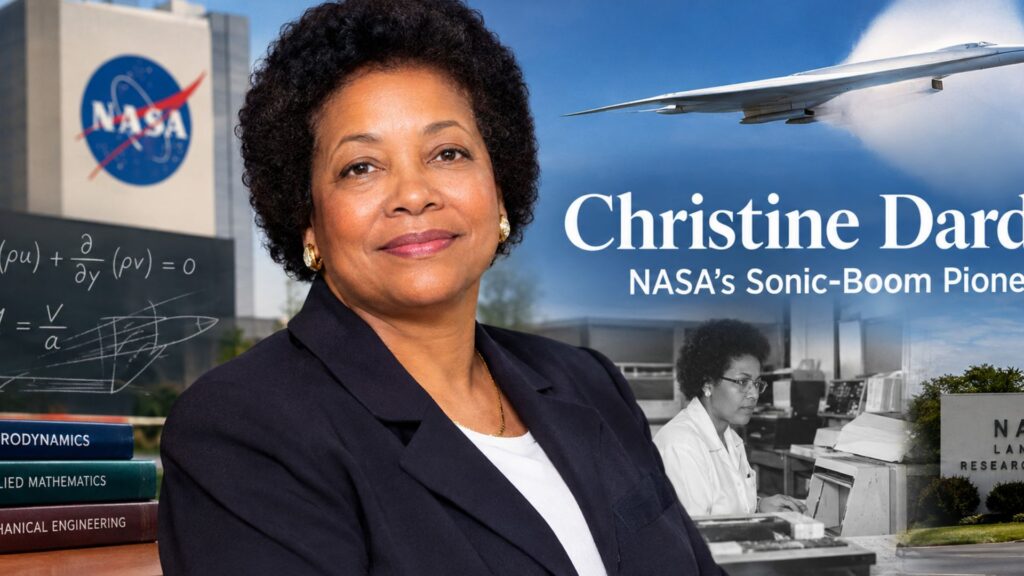

Christine Darden is a mathematician, aerospace engineer, researcher, and former NASA executive whose career helped advance the understanding of supersonic aircraft and sonic-boom reduction. She joined NASA’s Langley Research Center in 1967 as a data analyst and later became an aerospace engineer, eventually earning international recognition for her work on sonic-boom prediction and minimization. Her career also made history: she became the first African American woman at NASA Langley to enter the Senior Executive Service, the top rank in the federal civil service.
| Quick Bio | Details |
|---|---|
| Full Name | Christine Mann Darden |
| Born | September 10, 1942 |
| Birthplace | Monroe, North Carolina, USA |
| Profession | Mathematician, Aerospace Engineer, NASA Executive |
| Education | Hampton University, Virginia State College, George Washington University |
| NASA Career | 1967–2007 |
| Main Research | Supersonic flight, sonic-boom prediction and minimization |
| Major NASA Role | Technical Leader, Sonic Boom Group |
| Doctorate | D.Sc. in Mechanical Engineering, George Washington University |
| Major Honor | Congressional Gold Medal, 2019 |
| NASA Recognition | NASA Langley Hall of Honor, 2022 |
Early Life and Interest in Mathematics
Christine Darden grew up in Monroe, North Carolina, where her parents encouraged her and her siblings to pursue education and develop their abilities. From an early age, she showed curiosity about how things worked. NASA’s historical account describes her interest in taking objects apart and putting them back together and helping her father work on his car. Her interest in mathematics became especially clear during her school years.
Darden attended Allen High School in Asheville, North Carolina, during her final two years of high school. She graduated as valedictorian in 1958 and received a scholarship to Hampton Institute, now known as Hampton University. At Hampton, she studied mathematics and earned a bachelor’s degree in 1962, along with a teaching certificate.
Her early professional path initially followed education. She worked as a mathematics teacher, but her interest in advanced mathematics and scientific research eventually opened another door. She went on to earn a master’s degree in applied mathematics from Virginia State College in 1967.
Joining NASA Langley
In 1967, Darden began what became a 40-year career at NASA’s Langley Research Center in Hampton, Virginia. She initially worked as a data analyst and was part of the generation of women sometimes referred to as NASA’s “human computers.” These women performed complex mathematical calculations that supported aeronautical and space-related research before increasingly sophisticated computing systems became widespread.
Darden, however, wanted to move beyond data analysis and apply her mathematical training directly to engineering problems. After several years at NASA, she requested a transfer to the engineering department. In 1973, that request was granted, and she became an aerospace engineer. This transition marked a major turning point in her career.
Christine Darden and Sonic-Boom Research
Darden’s most recognizable scientific contribution came through her work on sonic booms. When an aircraft travels faster than the speed of sound, it generates shock waves that can reach the ground as a loud sound known as a sonic boom. Reducing the intensity of that boom became an important challenge for researchers investigating practical supersonic flight.
NASA records state that Darden’s first major assignment in this area involved developing a computer program related to sonic booms. That assignment developed into approximately 25 years of work focused on sonic-boom minimization. She became an internationally recognized authority in sonic-boom prediction, minimization, and supersonic wing design.
Her research included developing computer-based methods for determining the equivalent area of an aircraft designed to produce a lower sonic boom under particular flight conditions. Darden and a research partner subsequently designed models based on the equivalent-area concept and tested them in wind tunnels. According to George Washington University, a modified F-5 Sonic Boom Demonstrator test flight in 2002 helped validate the approach in actual flight.
This work was significant because quieter supersonic aircraft could potentially address one of the major practical problems associated with high-speed commercial flight: the disturbance created by sonic booms over populated areas.
Leadership at NASA
Darden’s career eventually expanded from technical research into leadership and program management. In 1989, she became the technical leader of NASA’s Sonic Boom Group within the Vehicle Integration Branch of the High Speed Research Program. In that position, she was responsible for developing NASA’s sonic-boom research program internally.
She continued to take on increasingly senior responsibilities. In 1999, Darden became a member of NASA’s Senior Executive Service after being named director of the Aerospace Performing Center Program Management Office. She later served as assistant director for strategic planning at Langley and eventually became director of strategic communications and education.
Her advancement was historically notable. NASA’s 2022 Hall of Honor citation recognized her career progression from “human computer” to the first African American woman at NASA Langley to reach the Senior Executive Service.
Education Beyond NASA
While developing her NASA career, Darden continued her academic education. She enrolled in George Washington University’s off-campus graduate program at NASA Langley and earned a Doctor of Science degree in mechanical engineering in 1983. Her doctoral work complemented her professional research in aerodynamics and sonic-boom minimization.
Her academic and professional background therefore combined mathematics, applied mathematics, mechanical engineering, computer-based research, and aerospace engineering. That combination became central to her work on supersonic aircraft.
Christine Darden and Hidden Figures
Darden is also associated with the wider historical story of African American women who contributed to NASA’s work. Her career is featured in Margot Lee Shetterly’s book Hidden Figures, which documented the contributions of African American women mathematicians and engineers at NASA and its predecessor organization.
There is an important distinction between the book and the 2016 film. Darden explained at George Washington University that she appears in the book but was not portrayed as a character in the movie. Her own NASA work also took place largely in aerodynamics and engineering rather than the specific space-flight calculations depicted in the film.
Awards and Recognition
Over the course of her career, Darden received numerous professional honors. George Washington University records that she received NASA certificates for outstanding performance multiple times, as well as the Black Engineer of the Year Award and the Candace Award for Science and Technology. NASA also lists the NASA Outstanding Leadership Medal and NASA Equal Opportunity Medal among her honors.
In 2019, Darden received the Congressional Gold Medal for her service as an aeronautical engineer. The medal was part of legislation recognizing Darden, Katherine Johnson, Dorothy Vaughan, Mary Jackson, and the broader group of women who worked as computers, mathematicians, and engineers at NACA and NASA during the space race era.
Another major recognition came in 2022, when Darden was inducted into the NASA Langley Research Center NACA and NASA Hall of Honor. NASA recognized her technical contributions to supersonic aircraft noise research as well as her trailblazing career in federal management.
Retirement and Legacy
Darden retired from NASA in 2007 after approximately four decades with the agency. NASA states that she authored more than 50 publications covering subjects such as high-lift wing design, supersonic flow, flap design, sonic-boom prediction, and sonic-boom minimization.
Her legacy extends beyond the number of publications or leadership positions she held. Darden’s career illustrates how mathematical expertise can develop into advanced engineering research and organizational leadership. Her progression from a data analyst to a leading authority on sonic-boom minimization also reflects the changing opportunities available to women and African Americans in American aerospace research.
Today, Christine Darden remains associated with NASA’s history of innovation, the development of quieter supersonic-flight concepts, and the broader story of women whose technical contributions helped shape American aerospace research. For readers of The Pure Magazine, her story offers a fascinating look at the person behind an important chapter in NASA’s scientific and engineering history.
FAQs About Christine Darden
Who is Christine Darden?
Christine Darden is a mathematician and aerospace engineer who spent approximately 40 years working at NASA’s Langley Research Center. She became internationally recognized for research into sonic-boom prediction and minimization.
What did Christine Darden do at NASA?
She began as a data analyst in 1967 and became an aerospace engineer in 1973. Her later work focused extensively on supersonic aircraft, sonic-boom research, aerodynamics, and engineering leadership.
What was Christine Darden’s major area of research?
Her best-known research area was sonic-boom minimization. She also worked on supersonic wing design, sonic-boom prediction, high-lift wing design, and related aerodynamic problems.
Was Christine Darden in the movie Hidden Figures?
Darden is featured in the book Hidden Figures, but she was not portrayed as a character in the 2016 film. She herself discussed this distinction during a George Washington University event.
What degree did Christine Darden earn?
She earned a bachelor’s degree in mathematics from Hampton University, a master’s degree in applied mathematics from Virginia State College, and a Doctor of Science degree in mechanical engineering from George Washington University.
When did Christine Darden retire from NASA?
Darden retired from NASA in 2007 after a career lasting approximately 40 years.
Did Christine Darden receive the Congressional Gold Medal?
Yes. In 2019, Darden was awarded the Congressional Gold Medal for her service as an aeronautical engineer.
Why is Christine Darden important in NASA history?
Her importance comes from both her technical contributions to supersonic-flight and sonic-boom research and her career progression into senior federal leadership. NASA later inducted her into the Langley Hall of Honor in 2022.
You May Also Readr https://thepuremagazine.co.uk/