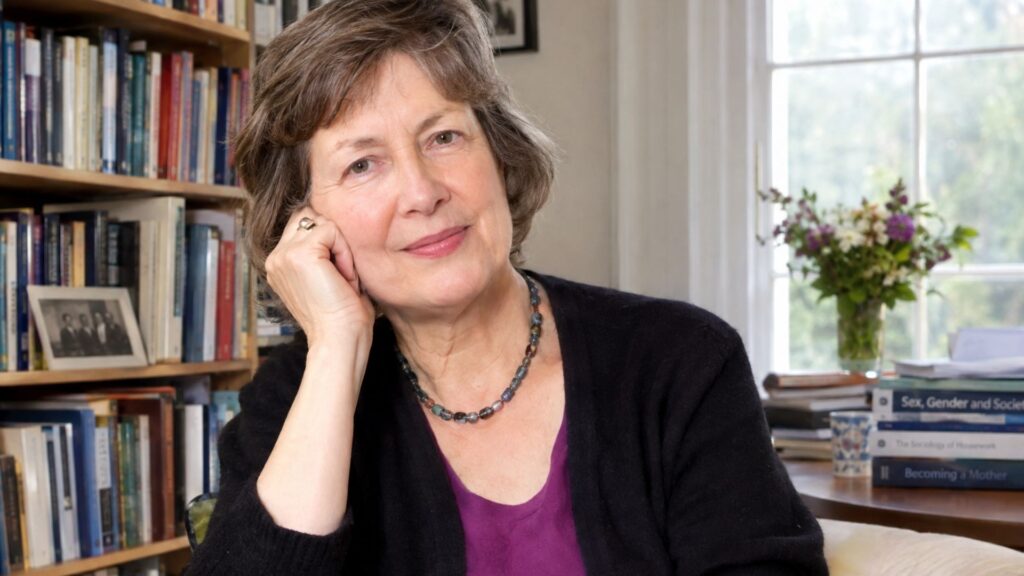

Ann Oakley is a prominent British sociologist, writer and feminist scholar whose work has played an important role in shaping discussions about gender, housework, motherhood, childbirth and women’s health. Over several decades, she has combined academic research with accessible writing, exploring how ordinary experiences can reveal much larger social and cultural structures. Her books and research have contributed to the development of women’s studies and have also influenced debates about research methodology and evidence-based social policy.
Ann Oakley was born Ann Rosamund Titmuss on January 17, 1944, in London, England. She grew up in an intellectually influential family. Her father, Richard Titmuss, was a leading British social-policy scholar, while her mother, Kathleen, worked as a social worker. This background gave Oakley an early connection to questions surrounding society, welfare and public policy. She later developed her own academic identity, becoming particularly interested in the experiences of women and the ways gender shapes everyday life.
Quick Bio of Ann Oakley
| Category | Details |
|---|---|
| Full Name | Ann Rosamund Oakley |
| Birth Name | Ann Rosamund Titmuss |
| Date of Birth | January 17, 1944 |
| Birthplace | London, England |
| Nationality | British |
| Profession | Sociologist, Writer and Feminist Scholar |
| Academic Fields | Sociology, Social Policy, Gender Studies |
| Known For | Research on gender, housework, motherhood and women’s health |
| Father | Richard Titmuss |
| Notable Book | Sex, Gender and Society |
| Academic Institution | University College London |
| Major Recognition | British Sociological Association Lifetime Achievement Award |
Early Education and Academic Development
Oakley attended Haberdashers’ Aske’s School for Girls before studying at Chiswick Polytechnic and Somerville College, Oxford. She completed her degree in 1965 and subsequently continued her academic education, eventually completing a PhD at Bedford College, University of London, in 1974.
Her doctoral research focused on women’s attitudes toward housework. The subject became a major foundation for her later academic work. At a time when domestic labor was often treated as a private matter rather than a serious subject for sociological investigation, Oakley examined housework as a form of labor and considered how it affected women’s identities, relationships and daily lives.
This approach became one of the defining characteristics of her career. Rather than separating private life from social science, she demonstrated how domestic experiences could provide important evidence about wider social arrangements.
Ann Oakley and the Study of Gender
One of Oakley’s most influential publications was Sex, Gender and Society, published in 1972. The book helped popularize an important distinction between biological sex and socially constructed ideas about gender.
Her work contributed to the growing academic understanding that expectations surrounding men and women are influenced not only by biology but also by family life, education, culture and social institutions. This perspective became particularly important in the development of gender studies and feminist sociology.
Oakley’s research also questioned assumptions about traditional roles. Her work examined how women came to be associated with domestic responsibilities and how these expectations were reproduced through everyday social practices.
The Sociology of Housework
Housework became one of the central themes of Oakley’s early career. Her 1974 book The Sociology of Housework developed ideas from her doctoral research and examined domestic labor from a sociological perspective.
Her research looked at women’s experiences of household tasks and challenged the idea that unpaid domestic work was insignificant simply because it did not normally receive a wage. By treating housework as an important subject of research, Oakley helped bring domestic labor into wider academic discussions about work, gender and social inequality.
Her work in this area remains an important reference point for researchers examining unpaid labor, household responsibilities and the division of work within families.
Research on Motherhood and Childbirth
Oakley’s interests later expanded into pregnancy, childbirth and motherhood. Her books Becoming a Mother and Women Confined: Towards a Sociology of Childbirth examined the experiences of women during important stages of their lives.
She explored motherhood not simply as an individual experience but as something influenced by medical institutions, family relationships, social expectations and wider cultural ideas. Her research encouraged greater attention to women’s own accounts and experiences.
Another significant work, The Captured Womb: A History of the Medical Care of Pregnant Women, examined the historical relationship between pregnancy and medical care. These studies strengthened her reputation as a scholar interested in women’s health and the social dimensions of medicine.
Academic Career and Research Institutions
Oakley became associated with the Institute of Education in London in 1985. She later played an important role in developing research institutions concerned with social science and evidence.
In 1990, she established the Social Science Research Unit. She was also involved in establishing the Evidence for Policy and Practice Information and Coordinating Centre, commonly known as the EPPI-Centre, in 1993.
This part of her career reflected another major interest: understanding how research evidence can be collected, evaluated and used in public policy. Her methodological work examined questions about how social research is conducted and how researchers can produce meaningful evidence.
Oakley has also been associated with University College London, where her academic interests have included sociology, social policy, gender and research methodology.
Feminism and Women’s Studies
Feminist scholarship has remained an important part of Oakley’s intellectual career. She worked with other prominent scholars and contributed to discussions about feminism, women’s rights and the position of women in society.
She co-edited works including The Rights and Wrongs of Women, What Is Feminism? and Who’s Afraid of Feminism? These publications reflected the continuing debate about women’s social position and the changing nature of feminist thought.
Oakley’s approach has often combined theoretical questions with detailed attention to everyday experiences. Her research demonstrates how subjects that may appear personal or domestic can also be connected to larger questions of social organization.
Books and Later Writing
Oakley’s bibliography extends well beyond sociology. She has written academic studies, feminist works, historical research, biography and fiction.
Among her notable publications are Experiments in Knowing: Gender and Method in the Social Sciences, Gender on Planet Earth, A Critical Woman, Father and Daughter: Patriarchy, Gender and Social Science, Women, Peace and Welfare and Forgotten Wives: How Women Get Written Out of History.
Her later writing has also explored historical figures and the ways women’s contributions can disappear from established accounts of history. In Forgotten Wives, she examined the experiences and contributions of women whose work has not always received the same recognition as that of men.
Her writing about her parents has also provided a more personal dimension to her intellectual biography. Her family background, particularly her relationship with the legacy of her father Richard Titmuss, became a subject of reflection in her later work.
Recognition and Legacy
Oakley’s contribution to British sociology has been formally recognized. In 2011, the British Sociological Association presented her with a Lifetime Achievement Award.
Her lasting influence can be seen in several areas of social research. She helped establish housework as a legitimate subject of sociological study, contributed to discussions surrounding sex and gender, investigated women’s experiences of motherhood and childbirth, and participated in the development of approaches to evidence-based social research.
Perhaps one of the most distinctive aspects of her career is the breadth of her interests. She has moved between academic sociology, feminist scholarship, social policy, methodology, biography and fiction while maintaining a continuing interest in how society shapes individual lives.
Why Ann Oakley’s Work Remains Important
Ann Oakley’s research remains relevant because many of the subjects she investigated continue to be discussed in sociology and public policy. Questions about unpaid domestic labor, gender expectations, motherhood, women’s health and the use of research evidence remain important areas of academic study.
Her career also demonstrates how social research can begin with apparently ordinary experiences. Housework, pregnancy, motherhood and family relationships can reveal broader patterns concerning power, institutions, culture and social expectations. By bringing these subjects into academic research, Oakley helped expand the range of questions considered important within sociology.
For readers interested in influential scholars, feminist history, gender studies and British sociology, Ann Oakley’s career offers a broad view of how academic research can connect personal experiences with major social questions. The Pure Magazine explores stories beyond the ordinary, and Oakley’s life and work provide a compelling example of how one scholar’s research can influence several fields of thought.
FAQs About Ann Oakley
Who is Ann Oakley?
Ann Oakley is a British sociologist, writer and feminist scholar known particularly for her research into gender, housework, motherhood, childbirth and women’s health.
When was Ann Oakley born?
Ann Oakley was born on January 17, 1944, in London, England.
What is Ann Oakley famous for?
She is especially known for her pioneering sociological research on housework and gender, as well as her studies of motherhood, childbirth and women’s health.
What is Ann Oakley’s most famous book?
One of her best-known books is Sex, Gender and Society, published in 1972. The Sociology of Housework is another important work associated with her early academic career.
Who was Ann Oakley’s father?
Her father was Richard Titmuss, a highly influential British social-policy scholar.
What did Ann Oakley research?
Her research has covered gender, domestic labor, motherhood, childbirth, women’s health, feminist scholarship, social policy and research methodology.
Has Ann Oakley received any major recognition?
Yes. The British Sociological Association gave Oakley a Lifetime Achievement Award in 2011 in recognition of her contribution to sociology.
Where did Ann Oakley work academically?
Oakley has been associated with several academic institutions, including the Institute of Education in London and University College London, and she has held an honorary fellowship at Somerville College, Oxford.
You May Also Readr https://thepuremagazine.co.uk/