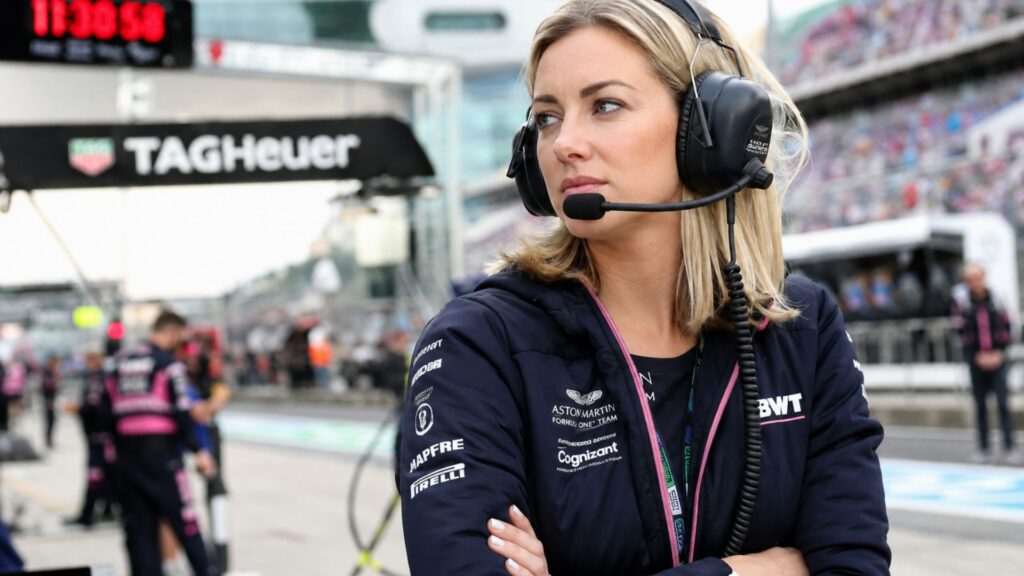

Bernadette Collins, better known to Formula 1 fans as Bernie Collins, has built an impressive career by combining engineering knowledge, race strategy and broadcasting. From her beginnings as a mechanical engineering student in Northern Ireland to working inside Formula 1 teams and eventually becoming a familiar face on television, Collins has developed a reputation for explaining the complicated world of motorsport in a clear and engaging way. Her career is particularly notable because she spent years making crucial decisions behind the scenes before bringing that experience to a much wider audience through her work as an F1 analyst.
Quick Bio of Bernadette Collins
| Detail | Information |
|---|---|
| Full Name | Bernadette “Bernie” Collins |
| Known As | Bernie Collins |
| Birthplace | Maguiresbridge, County Fermanagh, Northern Ireland |
| Nationality | Northern Irish / British |
| Education | Queen’s University Belfast |
| Field of Study | Mechanical Engineering |
| Profession | F1 Strategist, Engineer, Analyst and Broadcaster |
| Former Teams | McLaren, Force India, Racing Point/Aston Martin |
| Television Role | Formula 1 Analyst and Presenter |
| Book | How to Win a Grand Prix |
| Known For | Formula 1 race strategy and technical analysis |
Early Life and Education
Bernie Collins was raised in Maguiresbridge, County Fermanagh, Northern Ireland. Her interest in engineering developed at an early stage, and her educational path eventually led her to Queen’s University Belfast, where she studied mechanical engineering.
University played an important role in shaping her future career. Collins became involved with Formula Student, a competition that allows university engineering students to design, build and develop racing cars. This experience provided a practical introduction to motorsport engineering and helped her understand how theoretical engineering principles could be applied to real racing situations.
Her time at university also placed her in an environment where women were still relatively underrepresented in engineering and motorsport. Rather than discouraging her, this helped establish the foundation for a career in a highly competitive technical industry.
Starting Her Formula 1 Career at McLaren
Collins entered Formula 1 through McLaren’s graduate trainee programme in 2009. Joining one of the most famous teams in the sport gave her the opportunity to learn how a modern Formula 1 organisation operates.
During her early years, she worked in different engineering areas before progressing into performance engineering. Her responsibilities increasingly involved analysing the behaviour and performance of the car and using data to help the team make decisions.
By 2012, Collins had developed into a performance engineer, eventually working trackside and becoming involved with driver performance. In 2014, she worked with Jenson Button, the 2009 Formula 1 World Champion.
This period was significant because it gave Collins direct experience of the pressure surrounding Grand Prix weekends. Formula 1 engineers must process enormous quantities of information while making decisions within extremely short timeframes.
Moving Into Race Strategy
In 2015, Collins moved from McLaren to Force India. Her career there increasingly focused on race strategy and performance.
Race strategy is one of the most complex parts of Formula 1. Teams must constantly consider tyre degradation, weather, fuel, traffic, pit-stop timing, safety cars, red flags and the performance of rival cars. A decision that looks small from outside the circuit can completely change the outcome of a race.
Collins eventually became Head of Race Strategy within the organisation that later became Racing Point and then Aston Martin. Her role involved coordinating strategic decisions and helping determine how the team should respond to changing circumstances during a Grand Prix.
Her experience gave her a detailed understanding of what happens behind the scenes when viewers see a driver being instructed to pit, stay out or change their approach.
The Importance of Strategy in Formula 1
One reason Collins became such a valuable commentator is that race strategy can be difficult for casual viewers to understand. A Formula 1 race is not simply about which driver is fastest.
Teams continuously collect data and make predictions about tyre life, weather conditions and competitor behaviour. A driver may appear to be losing time but could actually be following a long-term strategy designed to preserve tyres. Similarly, a driver who pits early might be attempting an undercut, hoping to gain track position by completing a faster lap on fresh tyres.
Collins’ background allows her to explain these decisions from an engineer’s perspective. Instead of simply describing what happened, she can discuss why a team made a particular decision and what alternative options were available.
A Memorable Period With Racing Point
Collins was part of the Racing Point organisation during an important period in the team’s development. One of the most memorable achievements during that era was Sergio Pérez’s victory at the 2020 Sakhir Grand Prix.
That race became famous for its extraordinary circumstances, including an early incident that dropped Pérez to the back of the field and a dramatic sequence of pit-stop problems later in the race. Pérez eventually recovered to claim his first Formula 1 victory.
Although a Grand Prix victory belongs to the entire team, races such as this demonstrate the importance of strategy, communication and decision-making behind the scenes.
Transition From Team Strategy to Broadcasting
After years working within Formula 1 teams, Collins moved toward broadcasting and analysis. She joined F1 TV as an analyst in 2022 and subsequently became part of Sky Sports’ Formula 1 coverage.
The move was a natural progression because Collins had something particularly valuable for television audiences: first-hand experience of what happens inside a Formula 1 strategy department.
On television, she can translate technical information into understandable explanations. Her analysis often focuses on pit-stop timing, tyre strategy, weather conditions, team communication and the potential consequences of decisions made during a race.
Her presence has also contributed to the wider visibility of women working in motorsport’s technical and engineering roles.
Her Book, How to Win a Grand Prix
Collins expanded her work beyond television with the publication of How to Win a Grand Prix: From Pit Lane to Podium – the Inside Track, written with motorsport journalist Maurice Hamilton.
The book offers readers an insight into the complicated process behind a Formula 1 race. It explores areas such as car preparation, engineering, race weekends, strategy and the decisions that can influence a team’s performance.
For fans who normally see only the drivers and podium celebrations, Collins’ book provides a behind-the-scenes perspective on the many people whose work contributes to a Grand Prix result.
Recognition for Her Engineering Career
Collins’ achievements have received recognition outside Formula 1 broadcasting. She was included in the Forbes 30 Under 30 Europe list in the Manufacturing & Industry category in 2016.
She also received an honorary degree from Queen’s University Belfast in 2023, recognising her professional achievements and contribution to her field.
These honours reflect the wider significance of her career. Collins is not simply a television personality who discusses Formula 1; she spent more than a decade working within the sport and developed her expertise through practical engineering and strategic experience.
Bernadette Collins Today
Today, Bernie Collins remains closely associated with Formula 1 through her broadcasting and analytical work. Her technical knowledge makes her particularly useful when explaining complicated developments and strategic battles during the modern Grand Prix era.
Her career demonstrates how expertise gained away from the spotlight can eventually become a powerful form of public communication. She moved from analysing data inside a team to explaining that same type of information to millions of motorsport followers.
For aspiring engineers and motorsport enthusiasts, her journey also demonstrates that Formula 1 offers many career opportunities beyond driving. Engineering, strategy, data analysis, operations and broadcasting all play important roles in the sport.
Bernie Collins’ story is ultimately one of technical expertise, determination and career evolution. From studying mechanical engineering in Northern Ireland to working for major Formula 1 teams and becoming a respected television analyst, she has established herself as one of the sport’s recognisable technical voices. For readers interested in the people who make Formula 1 work behind the scenes, The Pure Magazine offers a place to explore stories that go beyond the headlines and introduce audiences to the individuals behind remarkable careers.
FAQs About Bernadette Collins
Who is Bernadette Collins?
Bernadette Collins, commonly known as Bernie Collins, is a former Formula 1 engineer and race strategist who later became a Formula 1 television analyst and broadcaster.
Where is Bernadette Collins from?
Bernie Collins is from Maguiresbridge in County Fermanagh, Northern Ireland.
What did Bernadette Collins study?
She studied mechanical engineering at Queen’s University Belfast and became involved in Formula Student during her university years.
Which Formula 1 teams did Bernie Collins work for?
Her Formula 1 career included work with McLaren and Force India, and she later continued with the organisation through its Racing Point and Aston Martin eras.
What is Bernie Collins known for?
She is particularly known for her expertise in Formula 1 race strategy, engineering and her ability to explain complex Grand Prix decisions to television audiences.
Did Bernie Collins write a book?
Yes. She co-authored How to Win a Grand Prix: From Pit Lane to Podium – the Inside Track with motorsport journalist Maurice Hamilton.
When did Bernie Collins move into broadcasting?
After leaving her Formula 1 team role, Collins moved into broadcasting and analysis, joining F1 TV in 2022 and subsequently becoming part of Sky Sports’ Formula 1 coverage.
You May Also Readr https://thepuremagazine.co.uk/