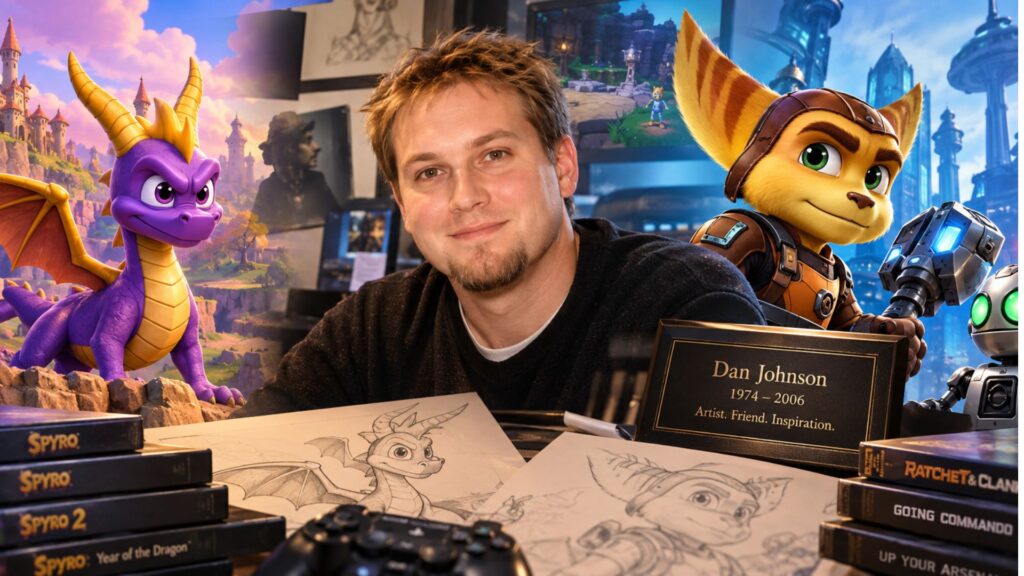

Dan Johnson, whose full name was Daniel Aric Johnson, was an American video game artist remembered for his contributions to Insomniac Games and some of the most recognizable platform games of the late 1990s and early 2000s. His work was connected with popular franchises such as Spyro the Dragon and Ratchet & Clank. Although he passed away in 2006 at the age of 32, his colleagues and the gaming community continued to honor his memory through tributes hidden within video games.
Quick Bio Table
| Detail | Information |
|---|---|
| Full name | Daniel Aric Johnson |
| Known as | Dan Johnson |
| Birth year | 1974 |
| Death date | December 3, 2006 |
| Age at death | 32 years |
| Nationality | American |
| Profession | Video game artist, animator, and modeler |
| Known for | Insomniac Games and video game character cameos |
| Notable franchises | Spyro the Dragon, Ratchet & Clank |
| Associated studios | Insomniac Games, High Impact Games |
Who Was Dan Johnson?
Dan Johnson was a video game artist whose work helped bring fictional worlds and characters to life. During an important period in the development of three-dimensional console gaming, artists like Johnson played a significant role in shaping how players experienced digital environments and characters.
Johnson was associated with Insomniac Games, the studio behind several successful PlayStation franchises. His credited work included environmental art, animation, character modeling, and rigging. These responsibilities required both technical knowledge and artistic creativity, helping developers create interactive worlds that felt visually engaging and consistent.
Unlike famous game directors or voice actors, Johnson was not widely known to the public during his lifetime. However, his presence became particularly meaningful to fans who discovered the references that developers placed in their games to remember him. His story demonstrates how the people working behind the scenes can leave a lasting impression on a creative industry.
Dan Johnson’s Early Career in Video Game Development
Dan Johnson began building his professional reputation during the late 1990s, when the video game industry was expanding its use of three-dimensional graphics. The original PlayStation created new opportunities for artists to design detailed environments, memorable characters, and imaginative worlds.
One of his early credited projects was Treasures of the Deep, released in 1997. He worked as a 3D animator on the game, gaining experience in a developing industry that required artists to combine creative ideas with the technical limitations of contemporary hardware.
Johnson subsequently became associated with Insomniac Games, where he contributed to the original Spyro trilogy. His environmental art helped support the colourful settings and imaginative landscapes that made these games distinctive. The work demanded attention to visual composition, atmosphere, and the relationship between game environments and player movement.
His early career coincided with a period when platform games were becoming increasingly ambitious. Artists needed to create visually interesting spaces while ensuring that players could navigate them smoothly. Johnson’s work formed part of the wider collaborative effort behind these influential releases.
His Contributions to Spyro the Dragon
The Spyro the Dragon franchise became an important part of Johnson’s professional history. He received credits connected with Spyro the Dragon (1998), Spyro 2: Ripto’s Rage! (1999), and Spyro: Year of the Dragon (2000). These titles helped establish Spyro as a recognisable character in the early PlayStation era.
The games transported players through colourful fantasy environments filled with unusual creatures, hidden treasures, puzzles, and exploration opportunities. Environmental artists contributed to the appearance and atmosphere of these locations, helping make each world feel distinct.
Johnson also became known among fans for appearances associated with the games. Some references to him were hidden in environmental details, making them easy to overlook during an ordinary playthrough. These discoveries later became part of the wider tradition of remembering him through the games he helped create.
His connection to Spyro demonstrates how contributions from artists can become part of a game’s identity even when their names are not familiar to most players.
Work on Ratchet & Clank
Johnson’s professional contributions continued with Ratchet & Clank, which launched in 2002. He was credited as a character modeler on the original game, and his subsequent work was associated with entries in the franchise. His documented gameography also includes Going Commando, Up Your Arsenal, Ratchet: Deadlocked, and Resistance: Fall of Man.
Character modeling involves creating the visual structures used to represent characters in a game. Rigging, another skill associated with Johnson’s work, involves establishing the systems that allow digital characters to move and animate. These tasks require artistic judgment as well as an understanding of how models function within interactive environments.
The Ratchet & Clank series combined action, humour, science-fiction settings, and distinctive character designs. Its development depended on collaboration between artists, programmers, designers, animators, and other specialists. Johnson’s work contributed to this shared creative effort.
His professional legacy is particularly visible through the franchise’s recurring references to him, which turned a colleague’s memory into an enduring part of the series’ history.
Dan Johnson’s Hidden Appearances and Tributes
One of the most interesting aspects of Dan Johnson’s story is the way his colleagues remembered him through in-game references. Rather than limiting their remembrance to traditional acknowledgements, developers incorporated his likeness and name into different parts of their games.
These appearances became familiar discoveries for dedicated fans. References associated with the Spyro and Ratchet & Clank franchises encouraged players to look more closely at background details, optional content, and hidden areas. Later games also included character appearances and other tributes connected with Johnson.
His likeness became especially recognisable through the Dan Johnson character and unlockable appearances in parts of the Ratchet & Clank series. Such additions gave fans a way to celebrate someone who had helped build the worlds they enjoyed exploring.
The practice of including developer references is not unique to Insomniac Games. Video game studios sometimes honour colleagues through hidden messages, character names, memorials, and credits. Johnson’s story is a notable example because references to him continued to appear well after his death.
Dan Johnson’s Death and Lasting Legacy
Daniel Aric Johnson died on December 3, 2006, at the age of 32. His death was a loss for his family, friends, and colleagues in the gaming industry. A memorial published in Game Developer magazine included condolences from Insomniac Games and High Impact Games, remembering his talent, humour, and friendship.
At the time, Ratchet & Clank: Size Matters was part of the franchise’s ongoing development. The game subsequently became one of the titles associated with his memory, and Ratchet & Clank Future: Tools of Destruction also carried a dedication to him. These acknowledgements ensured that players could learn about the person behind the recurring references.
Johnson’s legacy continued through later releases. Even players who discovered his character years after his death could appreciate the connection between the fictional world and the real people who helped create it. The continued presence of these tributes demonstrates how games can preserve personal and professional memories.
His career also highlights the importance of recognising the artists, modelers, and animators who work behind the scenes. While lead designers and performers often receive public attention, games are collaborative productions shaped by many individuals whose contributions deserve recognition.
Personal Life, Family, and Relationships
Publicly available information about Johnson’s private life is limited. His professional credits and memorial tributes provide a clearer picture of his work than of his family background, education, romantic relationships, or personal circumstances.
Consequently, details about a wife, partner, or children should not be presented as established facts without reliable evidence. Similarly, his exact birth date and birthplace are not confirmed by the principal memorial record cited here. What is documented is that he was born in 1974 and died in December 2006 at the age of 32.
Respecting these limits helps distinguish a factual biography from speculation. Johnson’s documented professional achievements and the affection expressed by his colleagues provide meaningful insight into his life without requiring unsupported personal claims.
Conclusion
Dan Johnson remains a memorable figure in video game history because of his artistic contributions and the thoughtful tributes that followed his death. His work on Spyro the Dragon and Ratchet & Clank formed part of an important era in console gaming, while his hidden appearances gave fans a personal connection to the developer behind the scenes. Although his life ended far too early, his influence continues to be remembered through the games and communities he helped shape. At The Pure Magazine, we recognise stories like Johnson’s because they remind readers that every beloved game reflects the creativity, dedication, and humanity of the people who bring it to life.
Frequently Asked Questions
1. Who was Dan Johnson?
Dan Johnson, whose full name was Daniel Aric Johnson, was an American video game artist and animator associated with Insomniac Games and the Spyro and Ratchet & Clank franchises.
2. How old was Dan Johnson when he died?
He was 32 years old when he died on December 3, 2006.
3. Which video games did Dan Johnson work on?
His credited projects include Treasures of the Deep, the original Spyro trilogy, several early Ratchet & Clank games, and Resistance: Fall of Man.
4. Why does Dan Johnson appear in Ratchet & Clank?
Developers incorporated references to Johnson into games as a way to remember and honour their former colleague. These appearances became memorable discoveries for fans.
5. Was Dan Johnson married or did he have children?
Reliable public sources do not clearly establish whether he was married or had children. These details should therefore be treated as unconfirmed.
6. What is Dan Johnson’s legacy?
His legacy includes his contributions to well-known video game franchises and the continuing tributes that preserve his memory among developers and players.
You May Also Read: dan johnson